
Even the best trailed verti cutter cannot bring ideal results if operated improperly.
Turf managers need to master the best timing, depth adjustment, operation path and post-care work before starting verticutting.
Wrong setting will cause turf thinning, yellowing and slow recovery, especially on sensitive golf green grass.
First, choose the proper verticutting window.
- ✔ Cool-season grass is suitable for verticutting in early spring and autumn during active growth.
- ✔ Warm-season grass such as Bermuda grass can be arranged in late spring and summer.
- ✘ Avoid verticutting under high temperature drought, frost period or right before big competitions, because turf needs recovery time.
It is recommended to stop irrigation 1–2 days in advance, slightly dry the turf surface to reduce blade clogging.
Second, set the working depth carefully.
This is the most important step.
Start with the shallowest setting and do a small test strip.
only groom surface thatch
for moderate thatch removal
Never set the depth too deep at one time.
Adjust the roller height to keep blades cutting evenly without scalping on uneven ground. Choose the forward speed steadily, avoid rushing, repeated cross-cutting can be arranged for heavy thatch areas.
Maintenance & Post-Care
After verticutting, clean up all thatch debris completely with brush sweeper or turf blower.
Then follow with light irrigation and reasonable fertilization to help turf recover quickly.
If you plan to combine overseeding or top dressing, arrange these works right after verticutting.
Regular machine maintenance: check blade sharpness, fasteners and bearing lubrication before each job.
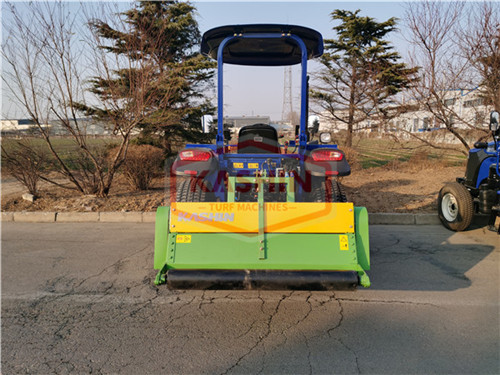
We supply trailed verti cutters matched with turf tractors, with multiple working widths for selection.
If you need training on operation and maintenance, or want to compare different models.
Post time: Nov-02-2026